
What is IoT (Internet of Things)? Meaning, Definition & How It Works

Learn about IoT and its place in modern life.
The Internet of Things (IoT) is the network of physical objects-devices with sensors and/or actuators, that connect to the internet to collect, share and act on data. In practice, things (from trackers to industrial machines) send data; platforms and apps make sense of it; and people or systems take action.
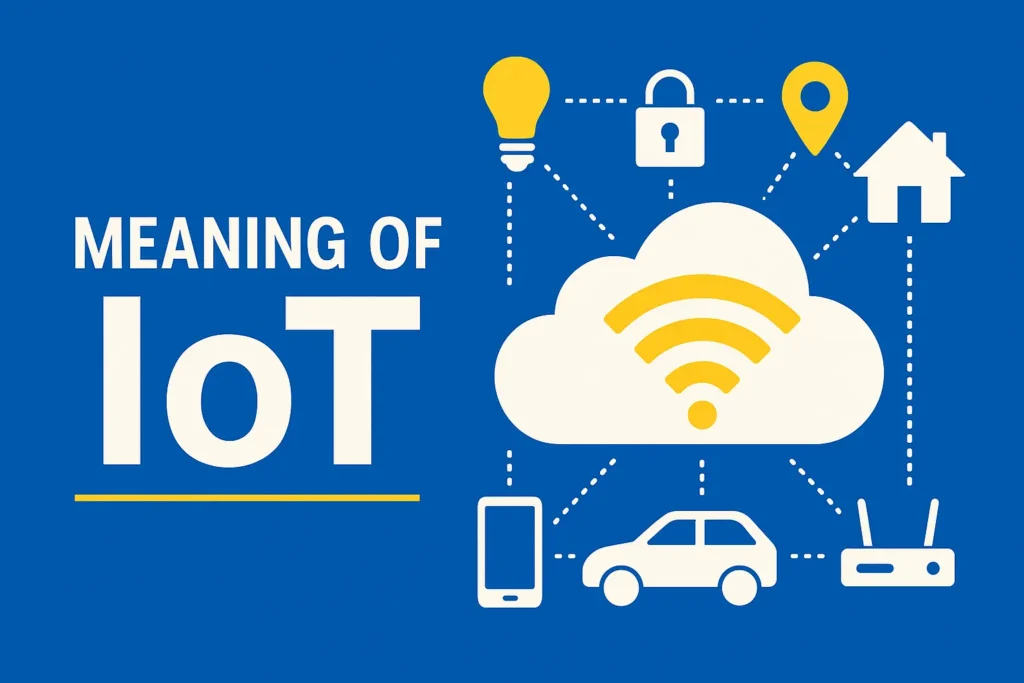
What does “IoT” actually mean?
Short definition: IoT is a system of connected physical devices that use sensors, connectivity, and software to generate insights and automate actions. (See industry explainers from AWS, McKinsey)
Core building blocks
- Devices & sensors: Measure temperature, vibration, GPS, energy use, occupancy, etc. Actuators perform actions (e.g., switch a relay, open a valve).
- Connectivity: Move data using Wi‑Fi, Bluetooth, Zigbee/Thread, LoRaWAN, and cellular options such as LTE‑M, NB‑IoT, LTE Cat‑1 bis, 4G and 5G. (See GSMA’s deployment resources for LTE‑M/NB‑IoT: GSMA Mobile IoT map.)
- Data & platforms: Edge or cloud software stores, processes, and analyses data; APIs integrate it into other systems; analytics and AI add predictions.
- Applications & action: Dashboards, alerts, automation and control loops deliver outcomes (e.g., predictive maintenance, smart metering, asset tracking).
Related terms (quick distinctions)
- IIoT (Industrial IoT): IoT for factories, utilities, logistics and other industrial environments (tighter reliability/safety, OT/IT integration).
- M2M (Machine‑to‑Machine): Older term for device‑to‑device comms, often cellular; overlaps with IoT but typically narrower (less cloud/app focus).
- Digital twins: Virtual models of physical assets fed by IoT data to simulate and optimise operations.
By the numbers: Market trackers estimated 16.6B connected IoT devices at end‑2023, rising to ~18.8B by end‑2024, and ~40B by 2030 (IoT Analytics).
How IoT works
Think in layers. Each layer has SEO‑relevant concepts users search for (protocols, architectures, security, analytics):
Device & edge layer
- Sensors/actuators on microcontrollers or embedded Linux boards.
- Edge computing runs filtering, rules, and ML inference locally to reduce latency and bandwidth; it also buffers data when connectivity drops. (AWS IoT architecture center)
- Device identity & trust: X.509 certs/keys, secure boot, hardware roots of trust.
Networks & protocols
Short‑range: BLE, Wi‑Fi, Zigbee/Thread (great for in‑building).
LPWAN: LoRaWAN for private/long range/low power.
Cellular IoT: LTE‑M and NB‑IoT (3GPP LPWA), LTE Cat‑1 bis, 4G/5G for higher throughput; roaming or private networks where needed. (GSMA, NB‑IoT, LTE‑M).
Messaging protocols: MQTT (pub/sub), HTTP/REST, WebSockets, CoAP (constrained devices), OPC UA in industrial settings.
Cloud & data pipeline
Ingest & routing: Device gateways authenticate devices, terminate TLS, and route messages to streams/queues.
Storage & analytics: Time‑series databases, data lakes, real‑time stream processing, AI/ML for anomaly detection and forecasting (e.g., AWS IoT Analytics).
Applications & integrations: Dashboards, alerts, digital‑twin models, API/webhook integrations into ERPs/CRMs/CMMS.
Act & automate
Rules engines trigger events (open a ticket, change a setpoint).
Closed‑loop control adjusts parameters automatically based on analytics.
Fleet operations: Device management (provisioning, configuration, OTA updates), observability, and incident response.

Benefits: why IoT matters
Operational efficiency: Automated data capture and workflows reduce manual checks, truck rolls and downtime.
Cost reduction: Optimise energy use, maintenance schedules and inventory; detect leaks/faults early.
New services & revenue: Usage‑based pricing, remote monitoring, service‑level reporting and outcome‑as‑a‑service.
Safety & compliance: Environmental monitoring, worker safety, asset custody, and audit trails.
Customer experience: Faster reactions, proactive support, and smarter products.
Sustainability: Fewer site visits, lower energy consumption, and better asset life‑cycle decisions.
M2M Data Connect Products
- FREE UK DELIVERY ON SIM ORDERS OVER £50
- UNBEATABLE BULK PRICE SAVINGS
- ONLINE SUPPORT 24/7
Need help, information, or want to order?
Risks and challenges
The rapid growth of IoT has created huge opportunities, but it also introduces complex risks and challenges that businesses and consumers need to plan for. These issues go far beyond technology – they impact trust, compliance, cost and the long‑term success of a deployment.
Security & privacy
Connected devices can be a target for attackers. Weak default passwords, unpatched firmware, or poorly secured cloud dashboards can expose sensitive data or allow attackers to hijack devices. Best practice involves:
- Enforcing unique credentials and secure onboarding.
- Encrypting data in transit (TLS) and at rest.
- Enabling secure boot and signed firmware to prevent tampering.
- Scheduling regular OTA updates and patch cycles.
- Limiting data collection to what is strictly necessary (data minimisation).
Real‑world example: botnets such as Mirai exploited vulnerable consumer devices to launch large‑scale DDoS attacks. (ETSI EN 303 645 guidance) provides a widely recognised baseline.
Interoperability & vendor lock‑in
IoT ecosystems often mix devices, platforms and connectivity from different suppliers. If standards aren’t followed, you risk fragmented systems, duplicated effort, and lock‑in to a single vendor. Using open protocols like MQTT, CoAP or OPC UA, and insisting on open APIs, reduces integration headaches.
Coverage & power constraints
IoT devices may be installed in basements, remote farms or vehicles that roam internationally. Choosing the wrong network can leave devices offline or drain batteries too quickly. LPWAN and cellular IoT technologies help, but coverage maps and realistic battery‑life testing are critical before rollout.
Lifecycle & scale
A pilot of 100 devices is very different from managing 10,000. Without proper lifecycle planning, companies face difficulties provisioning SIMs, rolling out firmware updates, or monitoring fleets. Cloud costs and platform licensing can also balloon unexpectedly at scale.
Total cost of ownership
The cost of IoT isn’t just hardware. Ongoing connectivity fees, platform subscriptions, integration projects, security operations, and end‑of‑life disposal all add up. Many organisations underestimate these, leading to projects that stall after pilots.
Regulatory & reputational risk
New UK and EU regulations (such as the UK Product Security regime and the EU NIS2 Directive) place legal duties on providers of IoT services. Failing to comply can mean fines, enforcement action, and brand damage. Privacy breaches under GDPR can have similar financial and reputational consequences.
IoT vs IIoT vs M2M (at a glance)
| Term | Primary context | Typical networks | Data/throughput | Focus | Example |
|---|---|---|---|---|---|
| IoT | Consumer & business | Wi-Fi, BLE, Zigbee/Thread, LoRaWAN, LTE-M / NB-IoT / Cat-1 bis / 4G / 5G | Low → high (varies) | Broad apps + cloud platforms | Smart meters, trackers |
| IIoT | Industrial / enterprise | Industrial Ethernet, fieldbuses, private LTE/5G, LoRaWAN | Low → medium | Reliability, safety, OT/IT integration | Condition monitoring |
| M2M | Legacy / point-to-point | 2G/3G/4G cellular, SMS, IP | Low | Transport layer only | Vending telemetry |
Choosing IoT connectivity & SIMs
At M2M Data Connect, our core offering is multi‑network IoT SIM cards that support 4G and 5G networks, alongside dedicated NB‑IoT SIM options. This means your devices always connect to the strongest available carrier wherever they are deployed, improving uptime and reliability.
4G/5G Multi‑Network IoT SIMs
- One SIM, maximum reach: Our SIMs automatically connect to the best available 4G or 5G carrier signal in the UK and abroad.
- Performance and flexibility: LTE 4G delivers widespread coverage and dependable throughput; 5G brings ultra‑low latency and higher capacity for data‑intensive applications like video monitoring or real‑time control.
- Scalability: A single SIM type works across consumer and enterprise IoT use cases, from payment terminals to industrial gateways.
Explore our range of 4G/5G Multi‑Network prepaid or postpaid IoT SIMs
NB‑IoT SIMs
Deep indoor coverage: Excellent penetration for basements, utility meters, and underground assets.
Ultra‑low power: Supports very long battery life for static sensors.
Low cost fleet management: Designed for massive deployments of simple devices.
Why multi‑network matters
Multi‑network roaming ensures your devices stay online even if one carrier experiences poor coverage or downtime. This is particularly valuable for logistics, utilities, agriculture and critical national infrastructure.

Additional options
- Fixed Public IP SIMs: for remote management and inbound connectivity (learn more).
- Private APN/VPN: secure data backhaul for enterprise environments.
- eSIM/eUICC support: change network profiles remotely without swapping physical SIMs.
Buyer’s checklist
Confirm coverage footprint (home and roaming) with multi‑network resilience
Match data traffic and latency needs to 4G, 5G, or NB‑IoT
Decide on inbound connectivity (Fixed Public IP vs. Private APN)
Verify device/module certification for target networks
Ensure strong security posture (TLS/mTLS, VPN, APN segregation)
Need help, information, or want to order?
Security & compliance (UK/EU)
Good practice (everywhere)
Unique credentials (no default passwords), secure onboarding, MFA for consoles
Signed firmware, secure boot, encrypted transport/storage, least privilege
Vulnerability disclosure policy and transparent support window
Regular OTA updates; staged rollouts with rollback
Data minimisation and clear retention policies
UK snapshot
The Product Security regime for consumer‑connectable products took effect 29 April 2024 (part of the PSTI framework). It bans universal default passwords, requires a public vulnerability contact, and mandates clarity on support/patch timelines. See UK government guidance (gov.uk) and the NCSC consumer explainer (ncsc.gov.uk).
EU snapshot
- NIS2 Directive strengthens cybersecurity obligations across 18+ sectors (risk management, incident reporting, supply‑chain security). Official overview: European Commission. (Adoption and national transposition varied through 2024–2025; monitor your operating countries.)
- Consumer IoT security baseline: ETSI EN 303 645 is widely referenced by regulators and certification schemes (etsi.org)
Privacy
For deployments involving personal data, treat GDPR/DPA obligations seriously: data minimisation, lawful basis, DPIAs, processor contracts and cross‑border transfers. UK ICO DPIA guidance: ico.org.uk.
Spectrum (UK context)
Ofcom outlines options for licence‑exempt spectrum vs licensed access for IoT services: ofcom.org.uk.
Getting started: a 10‑point checklist
- Define the outcome (what decision or action will data improve?) and write success KPIs.
- Map the environment (indoor/outdoor, mobility, RF obstacles, power and enclosure constraints).
- Pick hardware (sensors/actuators, module, antenna, enclosure, power/energy‑harvesting).
- Choose connectivity (see checklist above; plan for roaming & resilience; validate billing models).
- Plan identity & security (certs/keys, secure boot, secrets handling; align to ETSI EN 303 645 where relevant).
- Select platform (device mgmt, data pipeline, dashboards, APIs; consider costs at scale).
- Prototype (prove battery life, RF performance, data accuracy in real conditions).
- Pilot (few sites/assets; observe failure modes, message loss, and true recurring costs).
- Operate (monitoring/alerts, OTA policy, incident response, SLA, supplier support windows).
- Scale (automate provisioning, observability, firmware; forecast data/storage; plan for sunsetting and recycling devices).
FAQ
What does IoT actually mean?
A system of connected physical devices that capture, share and act on data, usually via cloud/edge software and apps. (See AWS and McKinsey.)
Is IoT the same as M2M?
Not quite. M2M is typically device‑to‑device transport (often cellular). IoT is broader: apps, analytics, APIs and user experiences built on the data.
What networks do IoT devices use?
Everything from BLE and Wi‑Fi to LoRaWAN and cellular (LTE‑M, NB‑IoT, Cat‑1 bis, 4G/5G). Choice depends on coverage, power, mobility and data needs. (Deployment resources: GSMA.)
Which protocol is best:
MQTT, HTTP or CoAP?For constrained devices and push‑style telemetry over unreliable links, MQTT is a strong default. HTTP/REST is ubiquitous for request/response and integrations. CoAP suits very constrained devices over UDP.
Is 5G required for IoT?
No. Many IoT fleets run on LPWAN (LoRaWAN) or 4G variants (LTE‑M, NB‑IoT, Cat‑1 bis). 5G helps when you need higher throughput/low latency (e.g., video) or private networks.
How many IoT devices are there?
Analysts estimated 16.6B connected IoT devices at end‑2023, growing to ~18.8B by end‑2024, with long‑term outlook ~40B by 2030 (IoT Analytics).
What are the biggest risks?
Weak device security, misconfigured cloud/app access, poor update processes, and supply‑chain gaps. Start with strong identity, encryption and an OTA plan.
Key IoT Platform Features
Unified Data Control
Unified Data Control from 150+ Carriers and connected device platforms. And over 350+APIs with existing customers to manage the entire device ecosystem.
Single Pane of Glass
View your SIMs and devices in a “single pane of glass” after easily inputting your IoT platforms and carriers. Makes things easier at a lower cost.
Lifecycle Device Management
Delivers a consistent process and user experience to manage device lifecycle - individually or in bulk. Set up automations to occur in near real-time.
Parent/Child Relationships
Unlimited Parent/Child Relationships for internal and external customers. This can also be used within a customer for business lines, geography, department.
Business Process Automation
M2M IoT Connect handles your back-office data management as well rule-based automation of business process (suspend SIM when subscription term expires).
Notifications/Anomaly Detection
Platform performs cloud-based near real-time device and usage anomaly detection daily or immediately via text or email, depending on the rules you establish.
Rating and Mediation
Customer billing plans can be decoupled from carrier invoices & rate plans - enabling revenue maximization. R&M creates the data to support integration with customer ERP or billing engine.
Rate Plan Optimization
Manage costs by revealing data, SMS, and roaming charges. View monthly costs in total and trended over time. Rate Plan Optimization reduces cost with usage-based rate plan optimization.
Reporting/Statistics/Analytics
Utilizes the power of the Azure tools to transform data into insights; visualize historic data; and define patterns and trends with predictive capabilities.
How a Private APN Works

Need help, information, or want to order?
Private APN Applications
IP CCTV cameras
Create safer cities, homes and businesses. Remotely monitor facilities and public spaces in real time with fixed IP SIMs.
Digital Signage
M2M Fixed IP SIM enables communication to the router or media player to manage digital signage content remotely.
Vending machines
Vending owners can remotely manage price adjustments, track stock and enable secure payments with a fixed IP SIM card.
Wind turbines
Two-way communication for response to security risks is vital to control shutdowns. Fixed IP SIMs offer resilience connectivity.
Renewable Energy
Secure remote connectivity to monitor and control the assets with fixed IP SIMs that operate in harsh, remote environments.
Smart meters
Connect energy assets to make energy distribution decisions smarter while empowering customers to do the same.
Transport & Logistics
Fleet management systems, asset tracking, connected road signs, traffic lights & speed cameras need fixed IP SIMs.
Health & Telehealth
Improve health outcomes and reduce costs with real-time visibility into diagnostic data, health alerts, and more
Mobile workforces
Secure 4G Fixed IP SIMs provide superfast, data only Internet connectivity using 4G mobile technology for mobile workforces.
Need help, information, or want to order?
Latest News
The Latest IoT Resources

eSIMs the Missing Link in the Internet of Things
eSIMs are already rapidly gaining traction within the Internet of Things industry. For instance, they are creating new opportunities for mobile network operators and manufacturers of

Fixed IP SIM Cards with public IP address assignments
Fixed IP SIM Cards with public IP address assignments enabling 4G mobile broadband connections that are fixed. Our 4G Fixed IP SIM Cards with public

What is a private APN network
A private APN (Access Point Name) routes mobile data traffic from mobile devices directly into organisations’ corporate data networks. As a result, the M2M devices
Take the next step
Speak to an Expert
"*" indicates required fields

Get a call back
0161 660 2492
Contact us