
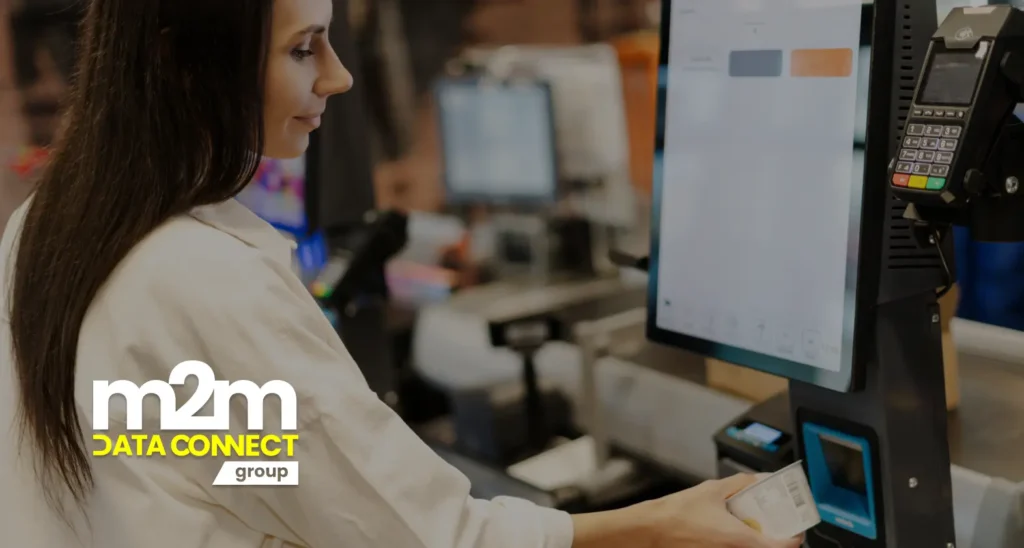
Reliable Connectivity for Connected Self-Service Kiosks
Smart kiosks are changing the way businesses deliver services, process payments and communicate with customers.
From self-service checkouts and ticket machines to information points and digital ordering systems, connected kiosks can reduce waiting times, improve accessibility and provide services beyond traditional opening hours.
However, every smart kiosk depends on reliable connectivity.
If a kiosk loses its connection, it may be unable to process a payment, confirm a booking, display live information or communicate with its central management platform.
M2M Data Connect provides secure, managed IoT connectivity designed to keep smart kiosks connected across a wide range of locations.
The Smart Kiosk Connectivity Challenge
Smart kiosks are often installed in busy public or commercial environments, including:
- Retail stores and shopping centres
- Airports and railway stations
- Hotels and hospitality venues
- Hospitals and healthcare facilities
- Car parks and transport hubs
- Restaurants and fast-food outlets
- Government buildings and public spaces
- Universities and education campuses
- Leisure centres and entertainment venues
- Outdoor and temporary locations
Many of these sites may not have a suitable fixed broadband connection available.
In other situations, connecting a kiosk to a customer’s internal network may create security concerns or require additional technical work.
Public Wi-Fi is rarely appropriate for business-critical equipment because it may be unstable, unsecured or difficult to manage.
A single-network mobile connection can also become unreliable when the kiosk is installed in an area with weak coverage from that specific operator.
For businesses managing multiple kiosks, the challenge becomes even greater. They need to monitor connectivity, control data usage, identify offline devices and manage every connection from one central location.
The Solution: Managed IoT Connectivity from M2M Data Connect
M2M Data Connect provides IoT SIM solutions that allow smart kiosks to communicate securely with cloud platforms, payment systems, booking software and remote management tools.
An IoT SIM can be installed directly into the kiosk or placed inside a compatible industrial 4G or 5G router.
This creates a dedicated mobile connection without relying on local Wi-Fi or fixed broadband.
Our multi-network IoT SIMs can connect to multiple mobile networks, helping kiosks maintain a more resilient connection across different locations.
This makes mobile IoT connectivity suitable for both permanent installations and temporary deployments where fixed internet access may be unavailable or impractical.
How Smart Kiosk Connectivity Works
Once connected, a smart kiosk can securely exchange information with the organisation’s central platform.
Depending on the application, this can allow the kiosk to:
- Process card and contactless payments
- Confirm bookings, orders or appointments
- Display live prices, availability or travel information
- Print tickets, receipts or collection labels
- Upload transaction and usage data
- Receive software and content updates
- Monitor stock levels and consumables
- Send fault and maintenance alerts
- Communicate with customer relationship management systems
- Support remote troubleshooting and device management
The kiosk can be monitored and updated remotely without requiring an employee or engineer to visit the site for every change.
Multi-Network Connectivity
Smart kiosks may be deployed across towns, cities, rural areas and large indoor environments.
Mobile network performance can vary significantly depending on the location, building structure and local coverage.
A SIM restricted to one mobile network may perform well at one site but struggle at another.
M2M Data Connect multi-network IoT SIMs provide access to multiple available networks, reducing reliance on a single operator.
This gives businesses greater flexibility when installing kiosks across a wide geographical area.
Multi-network connectivity is particularly valuable for kiosks located in transport environments, outdoor areas, temporary venues and remote sites where maintaining a reliable connection is essential.
Secure Data Transmission
Smart kiosks can handle sensitive information, including customer details, payment activity and booking data.
Secure connectivity is therefore an important part of every deployment.
M2M Data Connect can provide connectivity options such as:
- Private APNs
- VPNs
- Controlled network access
These solutions help protect communication between the kiosk and the organisation’s central systems.
Businesses can also apply restrictions to connected devices so they can only communicate with authorised platforms and services.
This helps reduce the risk of unauthorised access, misuse or unexpected data consumption.
Mobile connectivity can also separate the kiosk from a venue’s main business network, providing a dedicated connection for the device.
Centralised SIM Management
Managing connectivity across multiple kiosk locations can become difficult without a central management platform.
M2M Data Connect allows organisations to monitor and control their IoT SIMs from one place.
This can include:
- Activating and suspending SIMs
- Monitoring data consumption
- Setting data limits and usage alerts
- Reviewing connection activity
- Identifying unusual behaviour
- Checking whether devices are online
- Managing shared data allowances
- Producing usage and operational reports
- Controlling large numbers of connections
This visibility can help technical teams identify issues before they affect customers or interrupt kiosk services.
Smart Kiosk Applications
Self-Service Retail Kiosks
Retailers can use connected kiosks for product searches, customer check-in, stock enquiries, loyalty schemes and self-service checkout.
Reliable connectivity allows each kiosk to communicate with payment systems, stock platforms and customer databases.
Food Ordering Kiosks
Restaurants and hospitality businesses can allow customers to browse menus, customise orders and make payments without waiting at a staffed counter.
Orders can be sent directly to kitchen or point-of-sale systems.
Ticketing and Transport Kiosks
Connected kiosks can sell tickets, provide live travel updates, display route information and support passenger check-in at airports, railway stations and bus terminals.
Healthcare Check-In Kiosks
Hospitals, clinics and GP practices can use smart kiosks to manage patient check-in, appointment confirmation and wayfinding.
A secure connection helps ensure information is transmitted to the correct healthcare system.
Hotel Self-Service Kiosks
Hotels can offer automated check-in and check-out, room key collection, booking management and additional service purchases.
This can reduce queues and provide support outside reception hours.
Parking and Payment Kiosks
Connected parking kiosks can process payments, check vehicle registration details, issue tickets and communicate with central parking management systems.
Information and Wayfinding Kiosks
Public venues, shopping centres and corporate buildings can use connected kiosks to provide interactive maps, visitor information, directories and live announcements.
Key Benefits of IoT Connectivity for Smart Kiosks
Faster Deployment
Mobile connectivity removes the need to wait for a fixed broadband installation.
Kiosks can be installed and connected more quickly, even in temporary or remote locations.
Reduced Reliance on Local Networks
A dedicated mobile connection means the kiosk does not need to rely on public Wi-Fi or gain access to the venue’s internal network.
Improved Customer Experience
Reliable connectivity helps kiosks respond quickly, display accurate information and complete transactions without unnecessary interruptions.
Remote Monitoring and Support
Technical teams can monitor kiosk connectivity and receive alerts without being physically present at each location.
Reduced Engineer Visits
Many faults can be identified or resolved remotely, helping reduce maintenance costs and unnecessary site visits.
Scalable Connectivity
M2M Data Connect IoT connectivity can support growing kiosk deployments as organisations add more connected devices and locations.